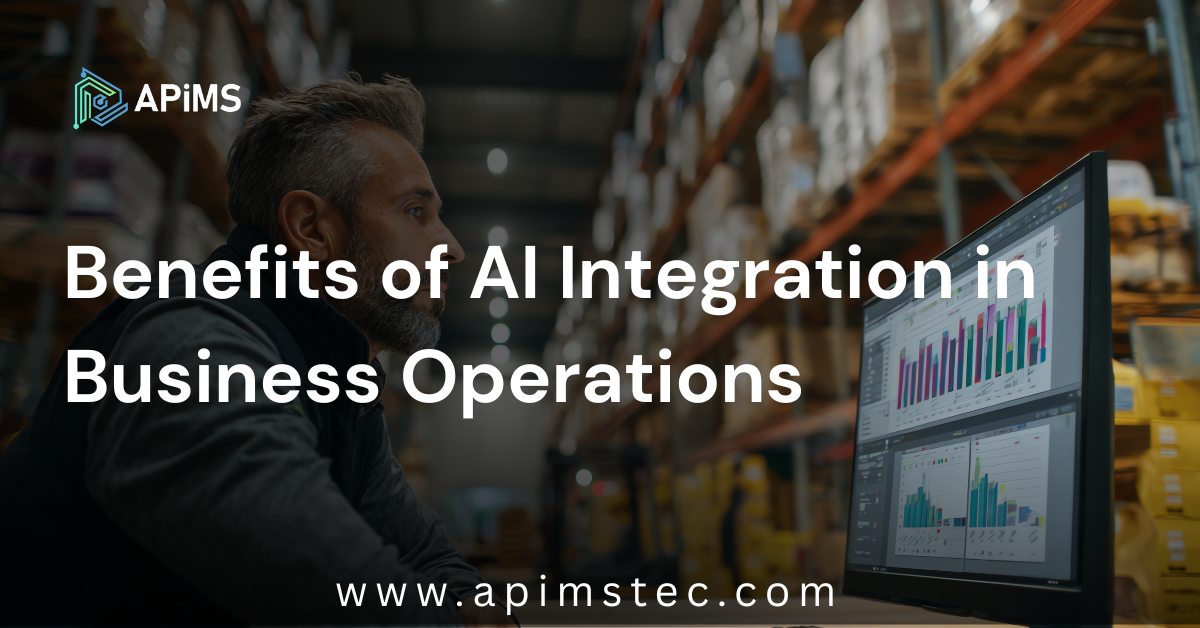
Most businesses in today’s competitive world adopt a strategy of AI integration to optimize processes and improve their competitive position. These opportunities extend from automating processes to deriving insights from large sets of data. Every day, new opportunities for growth emerge as new industries are created. This document clarifies the integration and highlight the different ways businesses can use the technology to enable growth while maximizing their profit.
What Is AI Integration?
AI Integration is the application of an AI program into a business’s current operational frameworks to improve productivity, streamline workflow processes, and enhancing decision-making. With AI, businesses are able to automate monotonous and time-consuming processes, real-time big data assessing tasks, and real-time agile determined operational tasks while computing machine level intuitive reasoning decisions. AI integration can improve the overall operational effectiveness and agility of a company. For example, businesses can improve customer AI Chatbot interactions, AI market trend analysis, or AI predictive analysis.
A good example of this is a retail business. Such a business can leverage customer data to predict purchasing behavior. This estimates future customer demand behavior to optimally stock inventory and avoid overstocking, thus boosting profitability.
Why Is Integrating AI So Important for Businesses?
Enhanced Productivity
One of the most prominent advantages of AI integration is the substantial rise in productivity. Labor-intensive tasks such as data entry, and basic customer inquiries, can now be automated with the power of AI. Increasing the pace of processes, and particularly eliminating human error, is a bonus. An instance of this is AI systems processing customer queries and even orders all day, every day, vastly improving customer satisfaction and response time.
Data-Informed Decision Making
Integrating AI also allows businesses to make smarter choices. AI can analyze vast amount of data sets to uncover trends and patterns which would be nearly impossible to identify reliably. This helps develop effective and improved business strategies, reliable predictions, and sharper marketing tactics. For instance, AI systems can analyze a customer’s purchase history and suggest targeted products to maximize upsell opportunities.
Decrease in Expenses
Reducing AI’s operational activities to a set of routine tasks can significantly lower structuring costs. Businesses can now maximize the use of their resources by utilizing them for high levels activities, rather than rote time-consuming processes. For example, instead of dealing with customer inquiries, your staff could dedicate their energy developing customer relations and new products.
Tailor-Made Customer Experience
Artificial intelligence is transforming personalized customer experience. With AI’s help, businesses can provide personalized product suggestions, design customer-centric marketing campaigns, and tailor the user experience. For example, Amazon employs AI-powered recommendation systems to suggest products to users, enhancing customer retention and increasing order completion rates.
How can AI be used in your Business?
To incorporate AI within your company, here is the clearest and most approachable framework to get you ready.
Step 1: Understand the Most Important and Profitable Parts of Automation
Every business believes something is more useful or something is more useful. In this case, the customers or users at the receiving end of the system could be Customer Service, Data Storage Systems, Sales Predictions, or Marketing in General. For example, AI could be used to support customer service agents with support tickets or leads for the company.
Step 2. Select Your AI Tools
Now it is time to select the tools you need. The success of your AI tools depends on these tools. Select AI tools which offer features that correspond to the various business functions you need. Some options are:
AI chatbots to manage customer service Automation tools for business intelligence and insights AI systems for customized and AI driven recommendations to users
Make sure that the AI tools you select align with your business goals and offer seamless integration into the workflows you already have.
Step 3. Configure Concepts in Your AI Tools
Various AI systems need to be trained and fed relevant data. The data the system learns from and improves its efficiency are the customer interactions of AI powered chatbots for example. AI driven recommendation engines learn from data available and customer purchases to make better suggestions for products.
Step 4. Track Performance
After implementing AI systems, you need to actively track how well AI tools are performing. Look at certain measures like the level of satisfaction of users, how long it takes to respond to questions and how much expenditure is saved. These parameters will help in deciding how effective the tools are. Based on these, it would be smart to make changes and improvements.
A Use Case Example of AI Integration into a Company
Let us now examine a company that illustrates AI Integration in practice. Netflix inc. employs Artificial Intelligence to personalize recommendations to each user. Netflix even customizes algorithms to assist in recommending movies and TV programs to a user based on their individual watching patterns.
AI integration has fostered user engagement and improved retention rates – people tend to stay longer on the platform with greater engagement. Netflix’s recommendation system is a benchmark of delivering user satisfaction. It illustrates the ability to use Artificial Intelligence to offer services that drive the success of the company.
AI Integration has a range of Positive outcomes for an organization like:
More Accurate Choices: Integration of AI allows businesses to assess huge amounts of data which increases the accuracy of analytics, thus making better business choices.
Increased Productivity: AI integration handles tedious and repetitive jobs which decreases the likelihood of human mistakes and allows your employees to dedicate their efforts towards fulfilling the bigger objectives.
More users sending requests: Companies that provide AI services stand a better chance to win more users with their improved personalized services which offer faster user satisfaction than the competitors.
The Future of AI Integration
The prospect of AI integration in businesses is very optimistic. AI tools will continue to improve and their ability to handle complex tasks will give valuable insights. Predictive analytics, automation, and improved customer experience will become increasingly common.
AI’s impact in healthcare could improve efficiency in diagnosing, planning treatments, and general patient care. AI tools will automate, design, and execute marketing campaigns, enhancing customer engagement and conversion rates. There is a vast potential for improvement, businesses that integrate AI will have a competitive edge.
Conclusion
The rapid development of technology in the world today means that businesses will have to embrace AI integration. Advanced AI automation tools perform and meet expectations in customer service. AI tools are systems investors want, readily available for purchase. There is quick growing return on investment, improved activity, lowered expenses, and insightful driven development.
More Info:
How to Integrate AI into Your Business & Apps
AI Integration for Web & App Automation